
Eight of the stones used to make the paths and steps at Belmont are embedded with dinosaur footprints. Dr. Robert E. Weems, a retired United States Geological Survey paleontologist, recognized the prints on a 2015 visit.
The stones originate from the ruin of the 18th-century mansion Mannsfield, about two miles south of downtown Fredericksburg on the Rappahannock River. Mannsfield burned during the Civil War, and the salvaged stone was sold early in the 20th century. Gari Melchers was one of the purchasers, and workers used the stone for paths and walls, as well as for building his studio.


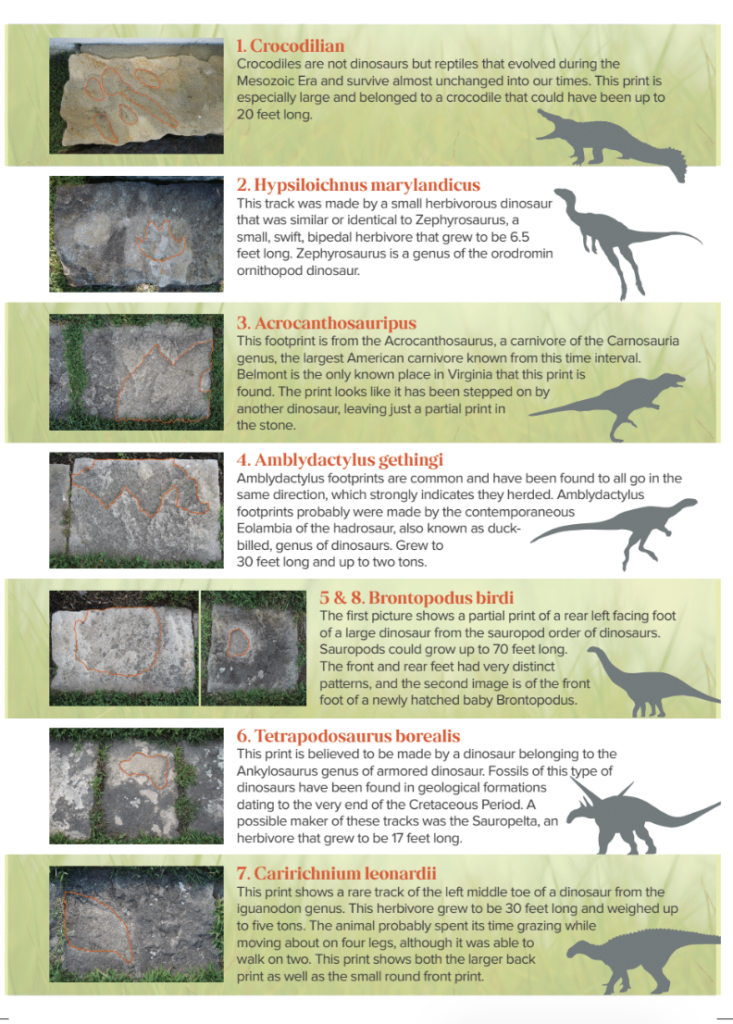
In 2015, Dr. Weems and amateur paleontologist Jon Bachman discovered outcroppings of sandstone rich in dinosaur footprints just upstream and downstream from the Mannsfield site. The prints formed on muddy river flats that were buried and eventually turned to stone.
It is believed that the stone from these areas was quarried at the Rappahannock and transported to Mannsfield, where it was used as building material. The stones were broken during the quarrying and original construction, and they were further worked at Belmont in the 1920s. But despite their jumbled history, the stones contain enough information to identify many partial footprints.
So far, nine kinds of Cretaceous dinosaur footprints have been found in Virginia, as well as crocodile, turtle, and frog footprints, but most are in areas that are difficult to reach. The prints in the garden at Belmont are easily accessible, and visitors can discover for themselves the signs of the animals that lived here during our distant past.
The prints can be difficult to see; the raking light of early morning or late afternoon is best for viewing them.
Please help us protect these prints by not disturbing the stones. A dinosaur print guide is available in the Museum Store.
Dinosaur prints formed in mud flats that existed in the Fredericksburg area during the Cretaceous Period of the Mesozoic Era about 110 million years ago. Footprints in this region are generally rare, except for a few areas in Stafford and Spotsylvania counties where sandstone deposits survive that formed along ancient stream beds. Vegetation inland from the riverbanks was quite thick during this period, so all but the largest dinosaurs used the less vegetated stream banks as a route of travel. Multiple animals traveled along the same pathways resulting in crisscrossing tracks, often one on top of the other.
The quality of the prints depends on the condition of the mud flats when each track was made. Soft mud sediment, for example, will push mud sideways, outward from where the foot lands, mounding mud up around the track. Some of the sediment then would flow back into the track, distorting and partially infilling its border. Harder mud will give a crisper print, but if the mud is too firm, only a faint or partial print will result.
Footprints cannot be directly associated with any particular skeleton species, so they have been given a separate set of scientific names for clarity of speech and thought. Names are correlated to the dinosaurs that made them, if known.
Further Reading
- Dinosaur prints to be included in Smithsonian collection
- Mannsfield Stone
- Digging Mannsfield
- The Age of Dinosaurs in Virginia and Nearby States (2022) by Robert E. Weems
- Cretaceous anuran and dinosaur footprints from the Patuxent Formation of Virginia, by Robert E. Weems, 1997, Proceedings of the Biological Society of Washington
- Enthusiasts Track Down Dinosaurs Along Riverbank (Washington Post archive), 2003
- The Lower Cretaceous Patuxent Formation Ichnofauna of Virginia (2015), by Robert E. Weems and Jon M. Bachman
- Additions and a Taxonomic Update to the Dinosaur Ichnofauna from the Patuxent Formation in Virginia, USA (2021)
Leave a Reply